
Save
Saved

Helsinki Central Station Set for Radical Green Makeover, New Designs Reveal

In a major shift toward sustainable urban living, the city plans to transform its busiest street into a sprawling, car-free pedestrian plaza by the early 2030s.

The City of Helsinki is planning to redesign the layout and appearance of the city center, according to an official statement.

Among others, the city is preparing to permanently remove private cars from the front of the Central Railway Station.

A new zoning plan, set to be reviewed by the Urban Environment Committee next Tuesday, March 17, aims to turn Kaivokatu into a pedestrian-first transit street.

Officials envision the area as an attractive, green “main entrance” to the Finnish capital.

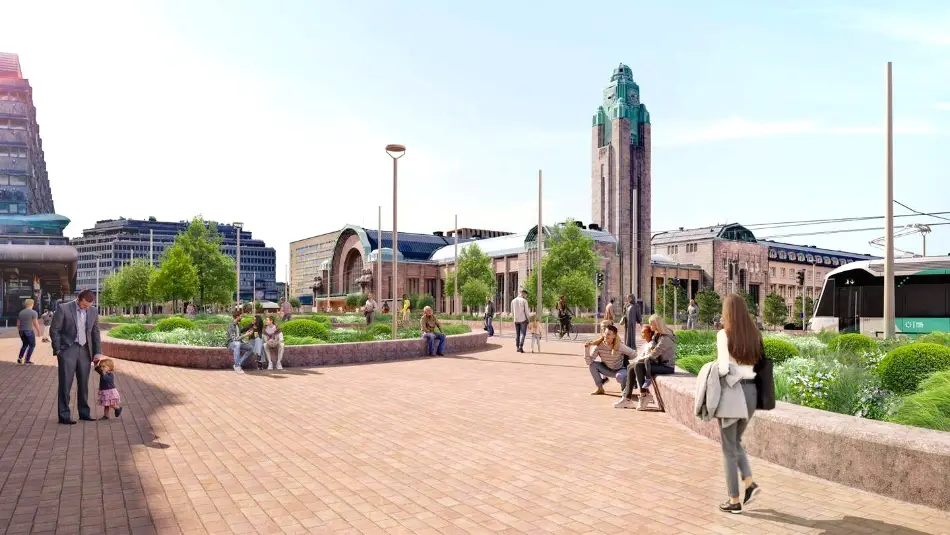
Under the new plans, the space between Mikonkatu and the Sokos department store will be entirely handed over to pedestrians, cyclists, and public transport.

The traditional sidewalks along Kaivokatu will disappear. They will be replaced by a wide, open square filled with seating areas, trees, bushes, and restaurant terraces.

Public transport capacity will also increase significantly in the area. The street will host stops for the new West Harbour light rail line.

This is how the Helsinki Central Station will look in a few years. Photo sketch: Ramboll Consulting

This redesign is part of Helsinki’s broader strategy to reduce private car dependency in the city center.

The number of tram tracks will double from two to four at the station. To make room for this urban oasis, private vehicle parking will be completely removed. Car drop-off zones will be relocated to the edges of the station square and the western end of Kaivokatu.

Commuter bicycle parking will be moved to the underground Kaisantunneli bike park. Meanwhile, bus traffic from the Railway Square terminal will be routed through Vilhonkatu in both directions.

This redesign is part of Helsinki’s broader strategy to reduce private car dependency in the city center. It aligns directly with Finland’s national climate goal to halve traffic emissions by 2030.

Like many European capitals, Helsinki is pushing to create a more walkable downtown to boost urban vitality and improve air quality. This transition continues despite some ongoing concerns from local retail owners regarding vehicle access.

The Kaivokatu transformation is closely tied to the massive renovation of the Esplanadi streets planned for the early 2030s. The city recently tested reducing car lanes on Esplanadi, laying the groundwork for this permanent traffic shift.

Construction on Kaivokatu will happen in two distinct stages, and the first phase is expected to begin in 2028.

Popular this week

Finland to get second Moomin theme park in Lapland

The creators of Finland's popular Moominworld are expanding to Rovaniemi to capitalize on the region's booming international winter tourism.

From Vantaa to Tampere: Why Major Finnish Cities Are Banning Face Coverings in Schools?

Vantaa and Tampere have introduced new guidelines prohibiting facial coverings in educational settings, sparking a nationwide debate over school safety, pedagogical interaction, and cultural expression.

Spring Weather Arrives Early Across Finland With Rare March Warmth

A high-pressure system is bringing exceptionally warm air to Finland, driving temperatures up to 15 degrees Celsius and rapidly melting snow much earlier than usual.

In Helsinki, Nepali Founders Are Building Their Own Mini Slush, and Rewriting Finland’s Startup Story

At the inaugural Bato Summit, more than 150 founders, investors, and dreamers gathered to prove that the next wave of Nordic innovation may have roots in the Himalayas.

End of an Era in Myllypuro as Helsinkiโ€™s Largest Food Bank Closes its Doors

After thirty years of feeding the vulnerable, the Myllypuro food bank is closing its doors because modern grocery stores and budget-conscious consumers have become too efficient at clearing out expiring food.

Topics

Finland to get second Moomin theme park in Lapland

The creators of Finland's popular Moominworld are expanding to Rovaniemi to capitalize on the region's booming international winter tourism.

From Vantaa to Tampere: Why Major Finnish Cities Are Banning Face Coverings in Schools?

Vantaa and Tampere have introduced new guidelines prohibiting facial coverings in educational settings, sparking a nationwide debate over school safety, pedagogical interaction, and cultural expression.

Spring Weather Arrives Early Across Finland With Rare March Warmth

A high-pressure system is bringing exceptionally warm air to Finland, driving temperatures up to 15 degrees Celsius and rapidly melting snow much earlier than usual.

In Helsinki, Nepali Founders Are Building Their Own Mini Slush, and Rewriting Finland’s Startup Story

At the inaugural Bato Summit, more than 150 founders, investors, and dreamers gathered to prove that the next wave of Nordic innovation may have roots in the Himalayas.

End of an Era in Myllypuro as Helsinkiโ€™s Largest Food Bank Closes its Doors

After thirty years of feeding the vulnerable, the Myllypuro food bank is closing its doors because modern grocery stores and budget-conscious consumers have become too efficient at clearing out expiring food.

Authorities Warn of Secret Extremist Home-schools in Helsinki

Security officials warn that isolated home-learning environments are becoming breeding grounds for extremism.

Finlandโ€™s Emergency Calls Needing Translation Surge by 770%

A massive 770 percent increase in translated emergency calls over five years reveals the daily realities of Finland's shifting demographics and its growing international community.

Helsinki Court Sentences Man for Aggravated Rape of 77-Year-Old Woman

A 77-year-old woman with dementia was assaulted in her home after offering help to an acquaintance.
spot_img

Related Articles

Popular Categories

spot_imgspot_img